Donal: Is Occupy Over?
Ramona's Piece de la Resistance (Including Pics of Obama, Romney, FDR)
dagblog To Give Away Logoed Hairshirt To Most Effective Lamenter Of Left's Ineptitude
|
Donal: Is Occupy Over? Ramona's Piece de la Resistance (Including Pics of Obama, Romney, FDR) dagblog To Give Away Logoed Hairshirt To Most Effective Lamenter Of Left's Ineptitude |
Read |
I stumbled across a site called SOPAOpera that's keeping track of who is and isn't supporting the Stop Online Piracy Act, or SOPA, and the PROTECT-IP Act, SOPA's counterpart in the Senate. The site also tracks how much money congresscritters have received from the entertainment and tech industries respectively. SOPAOpera lists the data source as OpenSecrets, which indexes FEC data. [Read more]
Note to the reader: I had originally planned to divide what follows as a series of posts in order to better present the ideas herein. However, I've decided to simply cram it all into one post in the interest of getting the ideas out there and hopefully sparking a discussion. I know that this isn't in the interest of good writing, but I think the prospect of getting these ideas out, here and now, is a more pressing matter. [Read more]
One interesting thing about the current American political climate is that you only ever seem to hear the phrase "class war" coming out of the mouths of those on the political right. Predictably, talk of raising taxes on millionaires, which I regard as a political slam dunk that probably should have been a center-piece of Democratic politicking for some time now, has also raised cries of class warfare from the right of the political spectrum.
President Obama addressed that claim today, but he did so by attempting to frame the debate as one of hard choices. It's not class war, said he, it's simply math. You can't keep the social programs Americans love and simultaneously reduce debt and deficits without new revenues. [Read more]
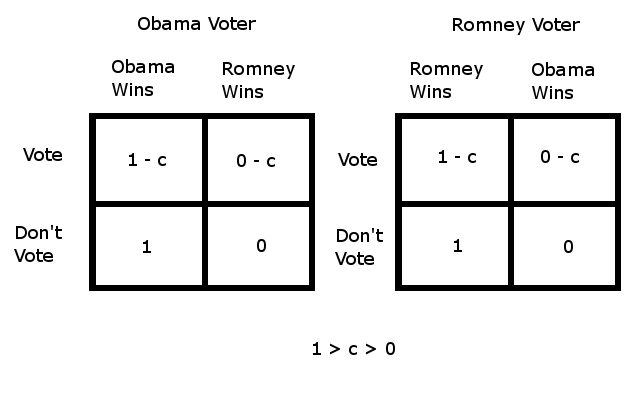
Our own Genghis recently wrote a post that posed the rhetorical question, "Why should you vote for Obama?" The purpose of his post seemed to be to spark thought and discussion about what Obama's potential campaign paths might be in the face of expectedly dreary economic conditions during the 2012 cycle, which reminded of a new model of presidential elections by UCLA's Lynn Vavreck. [Read more]
Via Mark Thoma, I have learned that Maxine Udall, Girl Economist, (born Alison Snow Jones) has passed away.
She was one of my favorite people in the econ blogosphere because she combined very sharp economic accumen with deep thinking about the moral implications of economic policy. Really, the best kind of economist.
She was a contributor to TPM Cafe and was linked to by Paul Krugman on a number of occasions.
I am sure she was many more things, but this was how I knew her.
She will be missed.
I think that it's fair to say we would all be in better shape if the current manifestion of conservatism in America looked less like Sarah Palin and more like David Frum. I really disliked his views of 9/11 and the Iraq War. He's also credited with coining the phrase "axis of evil." And he was not a crossover conservative in 2008, voting for McCain despite his opinion that Sarah Palin was unqualified.
But since then, he sounds increasingly sane to me. He was so vocal in his criticisms of GOP obstruction on healthcare reform that it led to a parting of the ways with the AEI. And on today's edition of Marketplace, he had this to say: [Read more]
About QE2, the venerable economist Sarah Palin has this to say:
When Germany, a country that knows a thing or two about the dangers of inflation, warns us to think again, maybe it's time for Chairman Bernanke to cease and desist. [Read more]
Punditry notwithstanding, this remains true: The sky is not falling. Aside from some specific details vis a vis Tea Partiers and ongoing demographic changes, there is pretty much nothing really surprising about what happened last night from an historical perspective.
First, "It's the economy, stupid!" The Democrats could not reasonably have been expected to hold the Whitehouse, House and Senate during relatively high levels of sustained unemployment. Not only that, but the things that Democrats did do to help the average American during a down economy, like the ARRA and lowering taxes, were not on the radar for many people. [Read more]
You know what would really simplify and improve the American political system presently? I'll tell you: We should all just give our money directly to corporations! At least, that's what Glenn Beck is apparently advising his audience to do in the form of making political donations directly to the Chamber of Commerce. Media Matters sums it up:
It’s such a twisted scheme that it’s easier to believe as a piece of performance art meant to mock right-wing pseudo-populism. Though if it was art, it would be dismissed as overly broad and heavy-handed. [Read more]
Ah, the World's Greatest Deliberative Body. No, not the courtroom of Judge Judy - the United States Senate. Once a bastion of the elite and much more a body that represented state legislatures than Da Peehpuhl (as we say here in California), then civilized by the 17th Amendment, it is now the Place Where Good Legislation Goes to Die on the Vine. [Read more]
PROTIP: If you're going to take someone to task for their supposed bigotry, it's probably best that your whole argument not devolve into a weird tirade about how Jews run everything... including the company that employs you.
Anyway, peace out to Rick Sanchez, whose Twitterfied brand of infotainment was the final nail in the coffin containing my erstwhile relationship with cable news two years ago. Cancelled my cable and haven't looked back.
Also, THIS IS EXCELLENT NEWS:

Meg Whitman has a maid problem. It's too early to know all the facts, but what Whitman knew and when she knew it isn't what really matters here. Even if she didn't know, she would still be guilty of one of the great Republican pastimes - the simultaneous persecution and exploitation of immigrants. [Read more]
Much has been written, both here at dagblog.com and elsewhere, about the rift between the so-called progressive left and their interlocutors in the halls of power. So much so, that the arguments seem fairly ossified at this point. I don't know that I can change of that, but I do have something for the offering nonetheless.
I recently read this post on Calitics, a very fine blog about California politics from a progressive point of view. The post in question highlights two essays that were recently written for the journal Democracy. [Read more]
Brad DeLong is a professor of economics at Cal. Megan McArdle is a hack in the employ of the Atlantic (for some reason).
Megan, meet Professor DeLong.
The real treat here is that McArdle comes by DeLong's blog to defend her stupidity in comments. DeLong, again, tries to clue her in. The fun comes when she finally realizes her simple (yet gargantuan) error and has to finally utter the resounding mea culpa of, "Oops." [Read more]
Seen here:

So, apparently we've reached the point in our present national decline when our modern day Father Coughlin has decided it's time for full-blown anti-intellectualism: [Read more]
Via Roger Ebert, I just learened tha Glenn Beck is set to hold an event in Anchorage, Alaska this September the 11th. I was able to confirm that tickets are on sale for the event here.
Ebert points to this article in Vanity Fair and speculates about the likely inclusion of Sarah Palin at such an event and speculates about a possible announcement of a run for the Oval Office. [Read more]
I'm offended. So, naturally, that places me amongst the majority of people living in the world today.
First off, it feels good to have outed myself as one of you. After all, the present condition of the "national dialogue" begins to make one feel rather left out when one is merely an observer of completely unrestrained outrage. Now that I've made my position known, I feel a lot better. [Read more]
Perceptive Dagblog readers know the difference between Obama, Romney and Bush:
Obama NYT today: .how President Obama’s thinking about what he once called “a war of necessity” began to radically change less than a year after he took up residency in the White House....The aide told Mr. Obama that he believed military leaders had agreed to the tight schedule to begin withdrawing those troops just 18 months later only because they thought they could persuade an inexperienced president to grant more time if they demanded it. “Well,” Mr. Obama responded that day, “I’m not going to give them more time.”...Mr. Obama concluded in his first year that the Bush-era dream of remaking Afghanistan was a fantasy...
Mitt Romney, Feb. 2012 : LAS VEGAS -- LAS VEGAS -- Republican presidential candidate Mitt Romney on Wednesday night blasted President Obama and his administration for “putting in jeopardy” the nation’s military mission by signaling it hopes to end its combat mission in Afghanistan by the middle of 2013.
Appearing at a campaign rally here shortly after landing in Nevada, Romney said Defense Secretary Leon E. Panetta’s statement Wednesday that U.S. forces would transition from a combat mission in Afghanistan next year “makes absolutely no sense.”....
George W. Bush, from May, 2003: BBC - "We do not know the day of final victory, but we have seen the turning of the tide... Free nations will press on to victory,"
Bush Afghanistan strategy : Gen. Douglas E. Lute, who had spent the last two years of the Bush administration trying to manage the many trade-offs necessary as the Iraq war consumed troop and intelligence resources needed in Afghanistan, arrived with a PowerPoint presentation. The first slide that General Lute threw onto the screen caught the eye of Thomas E. Donilon, later President Obama’s national security adviser. “It said we do not have a strategy in Afghanistan that you can articulate or achieve,” Mr. Donilon recalled three years later. “We had been at war for eight years, and no one could explain the strategy.”
Mitt Romney isn’t very far into the vice presidential selection process. But according to a dedicated band of conspiracy theorists, the pick is all but a lock: Sen. Marco Rubio.
That’s the current thinking among a worldwide collection of activists who are obsessed with the secretive Bilderberg Group, an alternating roster of global power players who loom as large — if not larger — in the online fever swamps of the fringe as the Trilateral Commission or the Council on Foreign Relations.
Read more: http://www.politico.com/news/stories/0512/76518.html#ixzz1vN5egowz
Aristotle and Plato didn’t agree on much, but they were united in identifying wonder as the origin of their profession. As Aristotle said, “It is owing to their wonder that men . . . first began to philosophise.” This idea appeals to scientists, who frequently enlist wonder as a goad to inquiry. “I think everyone in every culture has felt a sense of awe and wonder looking at the sky,” wrote Carl Sagan in 1985, locating in this response the stirrings of a Copernican desire to know who and where we are.
Yet that is not the only direction in which wonder may take us. To Thomas Carlyle, wonder sits at the beginning not of science, but of religion. That is the central tension in forging an alliance of wonder with science: will it make us curious, or induce us to prostrate ourselves in pitiful ignorance? We had better get to grips with this question before we too hastily appropriate wonder to sell science. That is surely what is going on when pictures from the Hubble Space Telescope are (unconsciously?) cropped and coloured to recall the sublime iconography of Romantic landscape painting, or the Human Genome Project is wrapped in biblical rhetoric, or the Large Hadron Collider’s proton-smashing is depicted as “replaying the moment of creation”. The point is not that such things are deceitful or improper, but that if we want to take that path, we should first consider the complex evolution of the relation between science and wonder.
[....]
Pretending that science is performed by people who have undergone a Baconian purification of the emotions only deepens the danger that it will seem alien and odd to outsiders, something carried out by people who do not think as they do. Daston believes that we have inherited a “view of intelligence as neatly detached from emotional, moral and aesthetic impulses, and a related and coeval view of scientific objectivity that brand[s] such impulses as contaminants”. It is easy to understand the historical origins of this attitude: the need to distinguish science from credulous “enthusiasm”, to develop an authoritative voice, to strip away the pretensions of the mystical Renaissance magus who acquired knowledge through personal revelation. We no longer need these defences, however; worse, they become a defensive reflex that exposes scientists to the caricature of the emotionally constipated boffin, hiding within thickets of jargon.