
MURDER, POLITICS, AND THE END OF THE JAZZ AGE
by Michael Wolraich


 Last week, the House of Representatives voted 410-8 to spend nearly $100,000 to engrave "In God We Trust" and the Pledge of Allegiance at the Capitol Visitor Center. The Wisconsin-based Freedom From Religion Foundation Inc. immediately sued to stop the engraving.
Legal history suggests that the challenge is unlikely to succeed. In 1970, the 9th Circuit Court of California ruled in Aronow v. United States ruled that engraving the "In God We Trust" on currency is constitutional. That ruling has been upheld twice, most recently in a 2005 suit by atheist Michael Newdow, who had previously won a Supreme Court case challenging the recitation of the Pledge of Allegiance in schools.
The Freedom From Religion Foundation may model its arguments on a 2005 case in which the ACLU successfully challenged the installment of framed copies of the Ten Commandments in front of two Kentucky courthouses. In that case, Justice David Souter (applying the Lemon test) ruled for a 5-4 majority that "the insistence of the religious message is hard to avoid in the absence of a context plausibly suggesting a message going beyond an excuse to promote the religious point of view...The reasonable observer could only think that the Counties meant to emphasize and celebrate the Commandments' religious message."
Statements by proponents of the resolution may support such an argument. Sen. Jim DeMint (R-S.C.) had previously criticized the Visitor's Center for ignoring the role of religion in the nation's founding, stating:
"There are a few articles in the CVC that reflect elements of faith -- two Bibles, a picture of the congressional nondenominational faith space, and the oath of office -- but I believe they grossly understate the prominent role of faith and Judeo Christian values in the history of this great building."
And in 2008, Newt Gingrich had petitioned Congress to require the CVC to present "the centrality of our Creator in the founding of America."
On the other hand, the conservatives' ire was motivated in part by omissions in the CVC displays. For example, a representation of Article 7 of the Constitution omitted the words, "In the Year of Our Lord." In addition, a replica of the House of Representatives Speaker's rostrum did not include the "In God We Trust" slogan which is engraved above the actual Speaker's rostrum. It would seem difficult to challenge an engraving in the CVC without also challenging the original in the House chamber.
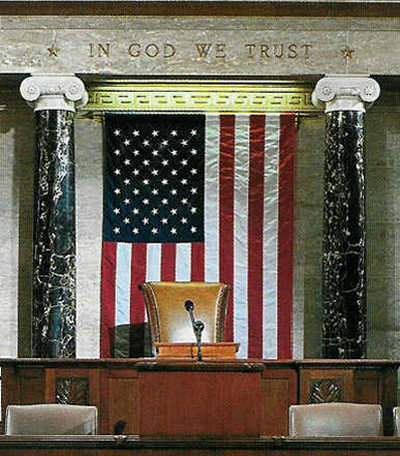
Though such an argument would be even less likely to succeed due to the precedents, I would prefer to see a challenge to the motto itself. In the 1970 precedent, Judge Bruce Thompson ruled:
"It is quite obvious that the national motto and the slogan on coinage and currency "In God We Trust" has nothing whatsoever to do with the establishment of religion. Its use is of a patriotic or ceremonial character and bears no true resemblance to a governmental sponsorship of a religious exercise...[The motto] is excluded from First Amendment significance because the motto has no theological or ritualistic impact."
With deference to the Judge Thompson, "it is quite obvious" seems a rather weak legal argument. The 1956 bill that established the slogan as an official motto cites as a primary rationale the fact that the slogan is inscribed on our currency. But according the Treasury Department, "In God We Trust" was first placed on U.S. coins in 1866 "because of the increased religious sentiment existing during the Civil War." Secretary of the Treasury Salmon P. Chase initiated the change after receiving a letter from a Rev. M. R. Watkinson of Pennsylvania with the following request:
One fact touching our currency has hitherto been seriously overlooked. I mean the recognition of the Almighty God in some form on our coins.
You are probably a Christian. What if our Republic were not shattered beyond reconstruction? Would not the antiquaries of succeeding centuries rightly reason from our past that we were a heathen nation? What I propose is that instead of the goddess of liberty we shall have next inside the 13 stars a ring inscribed with the words PERPETUAL UNION; within the ring the allseeing eye, crowned with a halo; beneath this eye the American flag, bearing in its field stars equal to the number of the States united; in the folds of the bars the words GOD, LIBERTY, LAW.
This would make a beautiful coin, to which no possible citizen could object. This would relieve us from the ignominy of heathenism. This would place us openly under the Divine protection we have personally claimed. From my hearth I have felt our national shame in disowning God as not the least of our present national disasters.
One week after the date on the letter, Secretary Chase instructed James Pollock, Director of the Mint at Philadelphia, to prepare a slogan for U.S. coinage:
Dear Sir: No nation can be strong except in the strength of God, or safe except in His defense. The trust of our people in God should be declared on our national coins.
You will cause a device to be prepared without unnecessary delay with a motto expressing in the fewest and tersest words possible this national recognition.
In the context of its origin, Judge Thompson's claim that the motto has "nothing whatsoever to do with the establishment of religion" seems strained to the say the least. Were such a slogan to be placed on our coins by Treasury Secretary Tim Geithner today, especially with such an explicit religious rationale, it would almost certainly be ruled unconstitutional following Souter's reasoning in the Ten Commandments case. And if the original establishment of the slogan on coinage was not constitutional, the logic declaring "In God We Trust" to be merely "patriotic or ceremonial" because of the history of the currency would appear to be circular. Judge Thompson's reasoning seems like a rationalization for continuing a tradition that should never have been started in the first place.
| Attachment | Size |
|---|---|
 igwt-house.jpg igwt-house.jpg | 92.55 KB |
| Coin2.jpeg | 14.62 KB |
Comments
"In God We Trust" was religious in 1866, but I think it presently holds more weight as a piece of history. If our nation were mostly atheist in its earlier histories, I would be fine (as an American) with federal buildings having inscriptions like "Atheism rules" or "Think for yourself". I think it's enough not being allowed to pray or read from religious books in federal buildings.
Also, the inscription being made isn't really a law. If Congress made an inscription on a rock that said "In God We Trust" and buried it, they wouldn't be making any ordinance that says that everyone under the jurisdiction of America must believe in God, which is what the concept of separation of church and state is (or at least seemed to originally be).
by Anonymous (not verified) on Tue, 10/06/2009 - 4:24pm
The issue is not a question of historical population. The framers included the "make no law respecting an establishment of religion" in order to protect believers in minority religions from tyranny by the majority religion, as happened to Puritans in England. And the proper comparison to a historically atheist state would not be "Think for yourself" but rather "There is no God." I think such a motto would seriously disturb many people and, more to the point, it would be unconstitutional.
Congress did pass a law in this case. The law requires that the Capitol Visitor Center display "In God We Trust." The motivation for the law, as stated by its supporters, was to emphasize the importance of Judeo-Christian (i.e. Protestant) faith to the Federal Government. This seems like the law concerns an establishment of religion to me, whether the engraving be buried underground or prominently displayed for tourists, but obviously, many people have come to a different conclusion.
by Michael Wolraich on Tue, 10/06/2009 - 4:53pm
It's clear you need to get a job. I you don't like "In God We Trust" don't look at it. Please allow me too look at it. I choose not to look at idiots. So if we cross paths some day please forgive me for not maiking eye contact.
Sincerely, Kelly J. Smith
by Kelly J. Smith (not verified) on Tue, 01/25/2011 - 5:26pm
Feel free to look at it - on your own dime. It's funny that you're chiding Genghis to get a job (which he most definitely has - in fact, he has several), but yet you want the government to spend $100k so that you can look at it, when you can do it for much, much cheaper with your own money instead of with mine, Genghis', and others.
by Verified Atheist on Tue, 01/25/2011 - 5:43pm