
MURDER, POLITICS, AND THE END OF THE JAZZ AGE
by Michael Wolraich


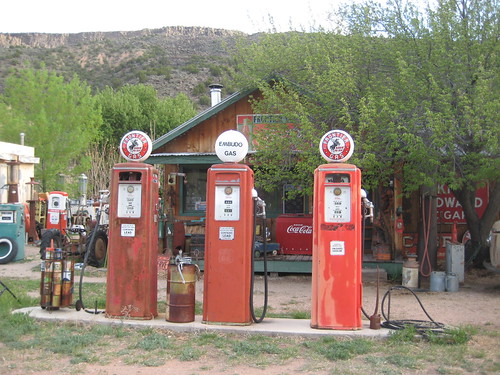
In Peak Oil Elasticity, Tom Whipple wonders why $4.00 fuel hasn't made Americans cut back our driving all that much:
One would think that with an increase in gasoline prices of over a dollar a gallon in the last year sales of gasoline would be slipping – and indeed they have, but not very much. With U.S. gasoline consumption running around 9 million b/d in last couple of years, consumption has only fallen by about 150,000 barrels a day, or 1.6 percent, compared with last year. Three years ago during a similar price spike, U.S. gasoline consumption fell by closer to 400,000 b/d. So far this year’s drop in consumption has not been enough to stem the rise in prices which in recent weeks have become more closely tied to the global supply/demand balance and the falling U.S. dollar.
Whipple concludes that demand is inelastic - people must drive - as long as the economy holds up:
This analysis suggests that at least for the immediate future we are not likely to see much of a drop in the demand for gasoline. If the economy slows further, then commercial demand for fuels by industry, business, airlines, etc. is likely to drop. ... For most there is currently no ready substitute for gasoline. When it comes to food, chicken or pasta can readily be substituted for beef, and restaurants bypassed. But for the mobility which is essential to our lifestyles few have an acceptable ready substitute. While U.S. gasoline consumption may fall by hundreds of thousands of barrels due to higher prices in the next few years, it is difficult to foresee it falling by millions.
In Will high oil prices bring a new recession? economist James Hamilton notes:
Ten of the 11 recessions in the United States since World War II have been preceded by an increase in oil prices. Does the recent surge in oil prices mean we should be looking for recession number 12?I've noted before that once energy expenditures get above 6% of average consumer spending, we start to see significant changes in spending patterns. We crossed that threshold in March, when 6.27% of every dollar spent went to energy-related goods and services. For lower-income groups, that expenditure share is significantly larger.
But Hamilton also recalls that we aren't driving the same cars we were in 2008:
I'm also suggesting that, precisely because consumers never went back to the earlier spending patterns on items like bigger cars, $4 gasoline will not have the same disruptive effects now that it did when we experienced these prices for the first time in 2008.
So perhaps Cash for Clunkers, hybrids and more efficient vehicles in general have simply raised the threshold at which people feel the pain. Commenting on Hamilton's post, aaron makes another good point - fewer of us have anywhere to go:
Based on disposable income minus the things people general consider not discretionary (food, gas, housing and utilities, healthcare), I don't think people are better off than in 2008. Healthcare in particular has continued its rise, so I think people's budgets are more fragile than in 2008. They are probably less willing and able to use debt to supplement their consumption.Gas price almost certainly won't have quite as big an impact, since the people who are driving likely have sufficient disposable income. The margins have already been removed from the roads. I think prices will more likely prevent people from returning to the roads rather than they will push people off of them.
The people that can still afford to drive, that still have jobs and cars - more efficient cars - have a higher threshold still.
Update: Today, Whipple says there is some panic at the pumps, but mostly overseas:
For a variety of reasons fuel and power shortages are continuing to appear in many corners of the world. In addition to the domestic shortages in Russia, long lines at gas stations were reported in Libya, Yemen, Kenya, Pakistan, Nepal, Chile, Senegal, Nigeria, Pittsburgh and parts of Georgia. [Pittsburgh?]
Electric power shortages in Pakistan continue to plague the country. It seems likely the country will soon have few, if any goods to export, and will be living on subsidies from foreign governments. Nepal is just about completely out of motor fuel due to the inability to pay its bills and India keeps upping its orders for foreign coal.
As a matter of interest, Hertz car rentals is now charging a fee of $9.29 a gallon to customers who do not return vehicles with full tanks.
Comments
I for one have cut back on my driving for several reasons one of which is the price of gas. I am also planning on moving up north to where there is public transportation and car sharing as was reported in you previous blog.
by cmaukonen on Wed, 05/04/2011 - 7:30pm
I didn't see what other necessities they cut back on so they can still purchase gas? It would be important to know what products were being abaondoned because that would make those items profit loosers and start an avalanche of failing product lines and businesses. An increase in the price for gas for a public strapped for cash would really kick the economy in the nuts really hard.
by Beetlejuice on Wed, 05/04/2011 - 8:06pm
Well, video stores are certainly tanking. Part of that is due to Netflix, but part may be due to fuel prices and having to drive to return DVDs, too.
by Donal on Wed, 05/04/2011 - 8:40pm
I was thinking more in the line of grocery stores not able to keep up with consumer demands. Their loading up carts full of hamburger helper, macaroni, canned and powdered soups, dried beans and rice. And the flip side would be a severe lack in sales of sodas, bottled water, candies, meats, fish, pork, poultry, fresh fruits and veggies and so forth. Consumers shopping on the cheap to offset the cost for gas and reduce trips to the market. A change in their buying habits at the grocery store is a sign of a primary needs category (food, shelter, clothing) being adjusted to satisfy secondary needs (gas, entertainment, sports, travel). Eventually, one can sacrifice only so much from a primary needs before there isn't enough to satisfy both...food wins over gas...so I suspect people are anticipating the cost will drop down in a few months. But what it if doesn't? And the economy keeps tanking and people still can't find full-time work, part-time work dries up, and more are either let go or their hours reduced? Sounds to me like everyone is betting it's a short-term crisis. I'm lucky to have a job (paid in dollars) with logisitc support here in Europe at a military installation because that $45 fill-up (11 gallons) on post would cost me the equilivant of $135 off post (high tax on petrol and an extremely poor exchange rate for the dollar). But I wonder how people would cope with paying $2 a quart? There have been times where I had no choice but to purchase gas on the economy. It's painful and you really do have to make short-term sacrifices in consumption of other items to offset the expense People may have no choice but to lower their living standards, keep the cooling/heating system off unless absolutely necessary, cut down on electicity and so forth. But those costs are rising too.
by Beetlejuice on Thu, 05/05/2011 - 5:38am
Back in Altoona, people on the edge have migrated to shopping at warehouse stores and dollar stores to find lower prices while traditional grocery stores seem to be going upscale and chasing the people that still have money. Lowe's and Home Depot used to jammed on weekends. They still do business, but are far less busy.
by Donal on Thu, 05/05/2011 - 7:53am
I am guessing that a lot of people don't know what their threshold is and are not keen to find out.
If income is getting progressively weaker, the scope of that problem is bigger than the increments through which it is manifested.
by moat on Wed, 05/04/2011 - 8:46pm
Particularly if there is a tipping point.
by Flavius on Wed, 05/04/2011 - 9:29pm
When we hit $4.00 last time, it was shocking, but we survived and the prices went down. Now, $4.00 doesn't seem quite so shocking...maybe at $5.00 that will change, who knows? At some point they have to get high enough to make us get serious about an energy policy that makes sense. We obviously aren't there yet.
by stillidealistic on Thu, 05/05/2011 - 1:06am
One thing I would like to add that the article fails to go into any detail on is gas prices over 10 years.
In 2003, I remember gas prices shot up over $2 a gallon. Today, the price is over $4 a gallon.
An annual growth rate of 7% means the price of an item doubles in 10 years.
Since this is the second time gas has been over the $4 threashold, the growth rate for the price is well above 7% so far and there's still 2 years to go before we hit the 10 year mark.
I'll look up my reference on this and work the numbers to see if \I can come up with an average ballpark growth rate .
by Beetlejuice on Thu, 05/05/2011 - 8:11am
From InflationData:
But early in 2011, we are again at $4.00/gallon.
by Donal on Thu, 05/05/2011 - 8:21am
Interesting graph. It's the sharp rise (2003 to 2008) where the speculators glean their profits. Odd that 2003 was the start of the Iraqi war.
by Beetlejuice on Thu, 05/05/2011 - 8:49am
I think to glean anything from this kind of chart regarding the economic impact on consumers and their pocketbooks, you have to adjust it for the improvements in gas mileage, and increases in length of commutes. Gas mileage for passenger vehicles since 1980 has improved something like 40%, and on the other hand commutes are 20% longer. So people need to drive a bit further than before, though they go a lot further per tank.
by Obey on Thu, 05/05/2011 - 8:57am
The following excerpts are from a presentation by Dr. Albert Bartlett. My point is consumption rates of a limited resource...gas...will follow the same pattern. It will be more voiliale and spike, however over a long run, say 10 years, there will be a steady and predictiable growth rate upon which speculators could use to gleen as much out of the public as possible. Notice how people are more settled with gas at $4 a gallon than they werea few years back...speculators are betting on that.
http://www.state.hi.us/dbedt/ert/symposium/bartlett/bartlett1.html
[page 6]
When a quantity such as the rate of consumption of a resource (measured in tons per year or in barrels per year) is growing at a fixed percent per year, the growth is said to be exponential. The important property of the growth is that the time required for the growing quantity to increase its size by a fixed fraction is constant. For example, a growth of 5 % (a fixed fraction) per year (a constant time interval) is exponential. It follows that a constant time will be required for the growing quantity to double its size (increase by 100 %). This time is called the doubling time T2 , and it is related to P, the percent growth per unit time by a very simple relation that should be a central part of the educational repertoire of every American.
T2 = 70 / P
As an example, a growth rate of 5 % / yr will result in the doubling of the size of the growing quantity in a time ...
T2 = 70 / 5 = 14 yr.
In two doubling times (28 yr) the growing quantity will double twice (quadruple) in size. In three doubling times its size will increase eightfold (23 = 8); in four doubling times it will increase sixteenfold (24 = 16); etc.
Also of interest ....
[page 3]
5) A table that I wish I had included in the original paper is one that would give answers to questions such as, "If a non-renewable resource would last, say 50 years at present rates of consumption, how long would it last if consumption were to grow say 4% per year?" This involves using the formula for the EET in which the quotient ( R / r0 ) is the number of years the quantity R of the resource would last at the present rate of consumption, r0. The results of this simple calculation are shown in Table I.
TABLE I
Lifetimes of non-renewable resources for different rates of growth of
consumption. Except for the left column, all numbers are lifetimes in years.
LIFETIME OF RESOURCE IN YEARS
ANNUAL GROWTH RATE
0%* 10 30 100 300 1000 3000
1% 9.5 26 69 139 240 343
2% 9.1 24 55 97 152 206
3% 8.7 21 46 77 115 150
4% 8.4 20 40 64 93 120
5% 8.1 18 36 56 79 100
6% 7.8 17 32 49 69 87
7% 7.6 16 30 44 61 77
8% 7.3 15 28 40 55 69
9% 7.1 15 26 37 50 62
10% 6.9 14 24 34 46 57
* 0% annual growth = "at current rate of consumption"
Example 1. If a resource would last 300 years at present rates of consumption, then it would last 49 years if the rate of consumption grew 6% per year.
Example 2. If a resource would last 18 years at 5% annual growth in the rate of consumption, then it would last 30 years at present rates of consumption (0% growth).
Example 3. If a resource would last 55 years at 8% annual growth in the rate of consumption, then it would last 115 years at 3% annual growth rate.
by Beetlejuice on Thu, 05/05/2011 - 8:37am